

13. What Are The Options For Filtering Data In Google Analytics?
You can control the data included in your reports using filters. They're useful because once you've created them they'll go along to be practical, so dissimilar segments, you don't need to add them each time you want to perform assay in your reports.
We're going to await at 8 essential filters you should consider applying to your data in Google Analytics. If you like, yous tin can leap straight to the filters:
- Exclude internal traffic
- Lowercase campaign tags
- Ensure data accurateness
- Lowercase folio URLs
- Lowercase site search terms
- Add domain name to reports
- Only include a specific domain (or domains)
- Search and replace
In this post we're as well going to answer the following questions:
- What are filters?
- How do you create filters?
- What types of filters tin you create?
- Tin can I apply multiple filters?
- What are the critical filters I should create?
- Which filters should I avoid?
Let'due south get started!
What are filters?
Filters let you to control which data is included (and not included) in your reports. And unlike segments and table filters, view filters permanently modify the data that'south available in a reporting view. This might sound scary, but there are times when you might want to permanently prevent information from appearing in your reports.
The nigh common view filter that people create is a filter to exclude internal traffic from showing inside Google Analytics. This is where you remove your own visits then that you have cleaner, more authentic data in your reports. If you lot work at a large system, and so internal visits could have a meaning impact on your information and tin skew important metrics similar conversion charge per unit.
Now that we've covered what filters are nosotros're going to expect at how you can create filters inside your account. If you're new to Google Analytics and you lot're not familiar with terms like views and backdrop, then I recommend downloading my Google Analytics Glossary before you lot keep.
How do you lot create filters?
Filters tin can be applied to 1 (or more than) of your reporting views within your Google Analytics account. You'll demand edit-level permission for the view to create and apply filters.
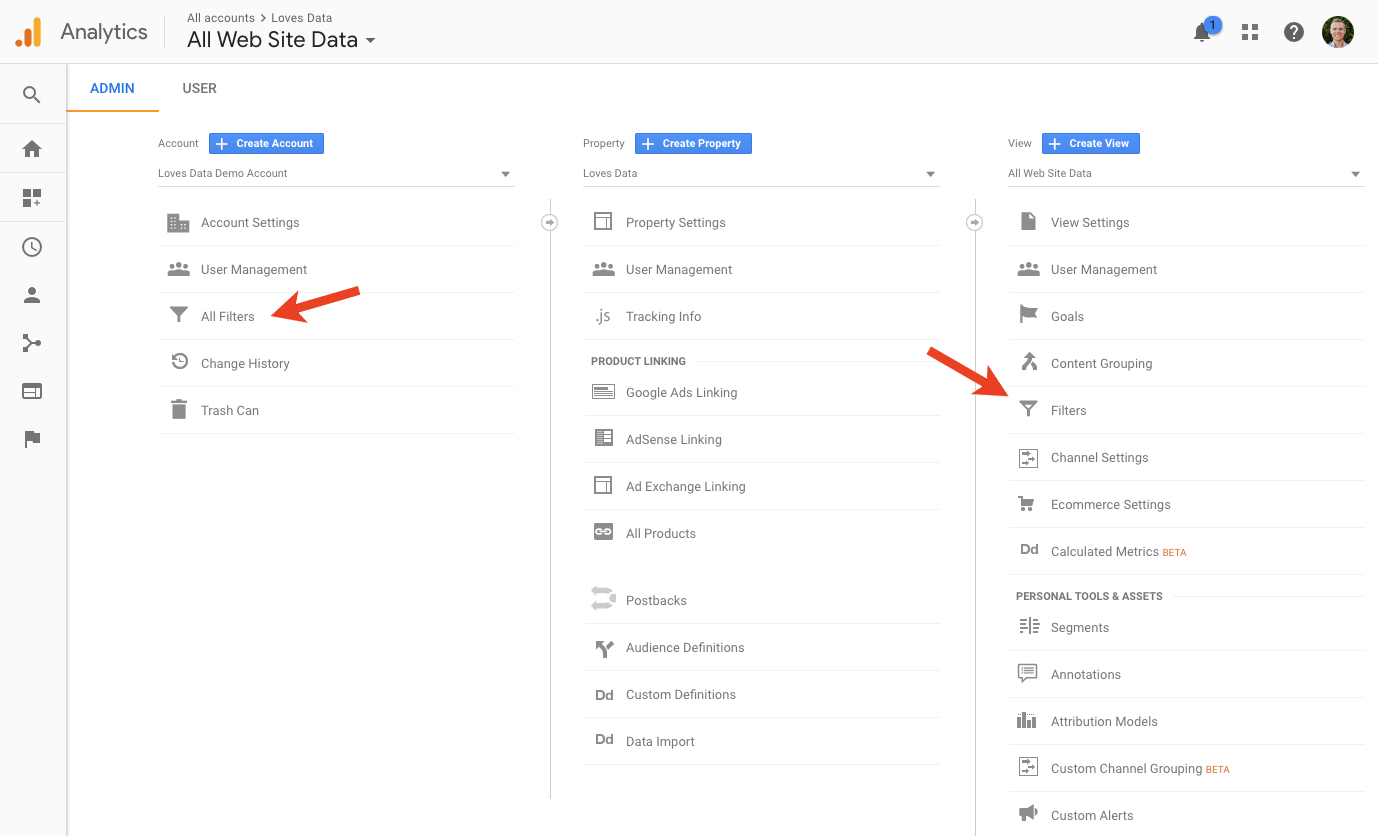
To create a filter navigate to 'Admin' and then select 'Filters' under the view column on the right (or 'All Filters' under the business relationship column on the left).
It'southward best practice to have at least three views for each property inside each Google Analytics account. I recommend checking that you lot accept the following views created for each belongings:
- Primary reporting view – this is what you'll employ for your regular reporting and assay. You'll employ filters to this view that remove your internal visits and any other filters that are needed to provide a cleaner, more authentic set of information.
- Raw reporting view – this is a fill-in set of information. It won't accept any filters applied, and hopefully, you'll never need to use it.
- Test reporting view – you'll simply employ this view for testing. For example, you tin apply new filters to this view to ensure they work every bit you expect before they're applied to your primary view.
If you're setting up these views for the beginning fourth dimension, then check to see if any filters are applied to the view that already contains data. If the view already has appropriate filters practical, so proper noun it something similar 'My Company – Primary' then that information technology's clear this is your solar day-to-day fix of reports. And so you can create a new view and proper name information technology 'Raw' and another called 'Test'. To create a new view click 'Create View' at the top of the view column on the right.
At present as you lot've probably guessed, I recommend adding filters to your testing view before you add together them to your primary view. Information technology'south improve to exist rubber since there is no undo when it comes to your information in Google Analytics!
What types of filters tin can you create?
Yous can create filters using pre-divers templates, or you can create custom filters. When you create a pre-divers filter, you can cull to exclude (or only include) traffic based on:
- Isp domain – allows you lot to filter based on the domain of your Internet access provider (Isp). This is but useful if you lot're with a larger organization (think multinational corporation or academy) that has its ain dedicated internet.
- IP addresses – when you connect to the cyberspace you lot'll be using an IP accost. Virtually retail (domestic) internet providers requite you a dynamic IP address which can modify. And so the best way to filter information using IP addresses is to ensure you lot have a static IP accost which doesn't modify.
- Sub-directories – you lot tin use this template to only include (or exclude) traffic from 1 of your website's sub-folders. For instance, if yous wanted a reporting view that only contained traffic to your https :// world wide web . lovesdata . com / blog / sub-folder, so you can enter /weblog/ into the template.
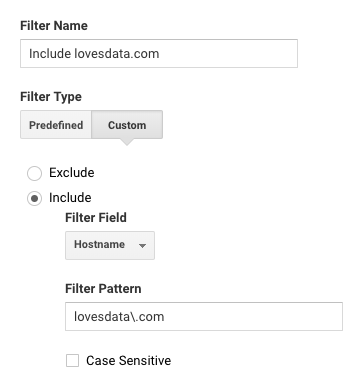
- Hostname – allows yous to include (or exclude) traffic based on domain name. For example, if you lot have your tracking code on https :// www . lovesdata . com and https :// www . analyticsacademy . com, then you add a filter with the hostname of lovesdata . com to only include traffic for your primary website.
Custom filters provide greater flexibility, assuasive you to:
- Exclude information
- Include information
- Change information to lowercase
- Alter information to uppercase
- Search and replace
- Create an advanced filter to modify data
Tin I apply multiple filters?
Yes, you can create and utilise multiple filters inside Google Analytics. However, the order you apply multiple filters to a unmarried reporting view matters. Hither's a unproblematic scenario to explain what happens… Allow's say we but want to include two sub-folders in our reporting view. We want to include the /weblog/ and the /courses/ folders. Then we create two filters:
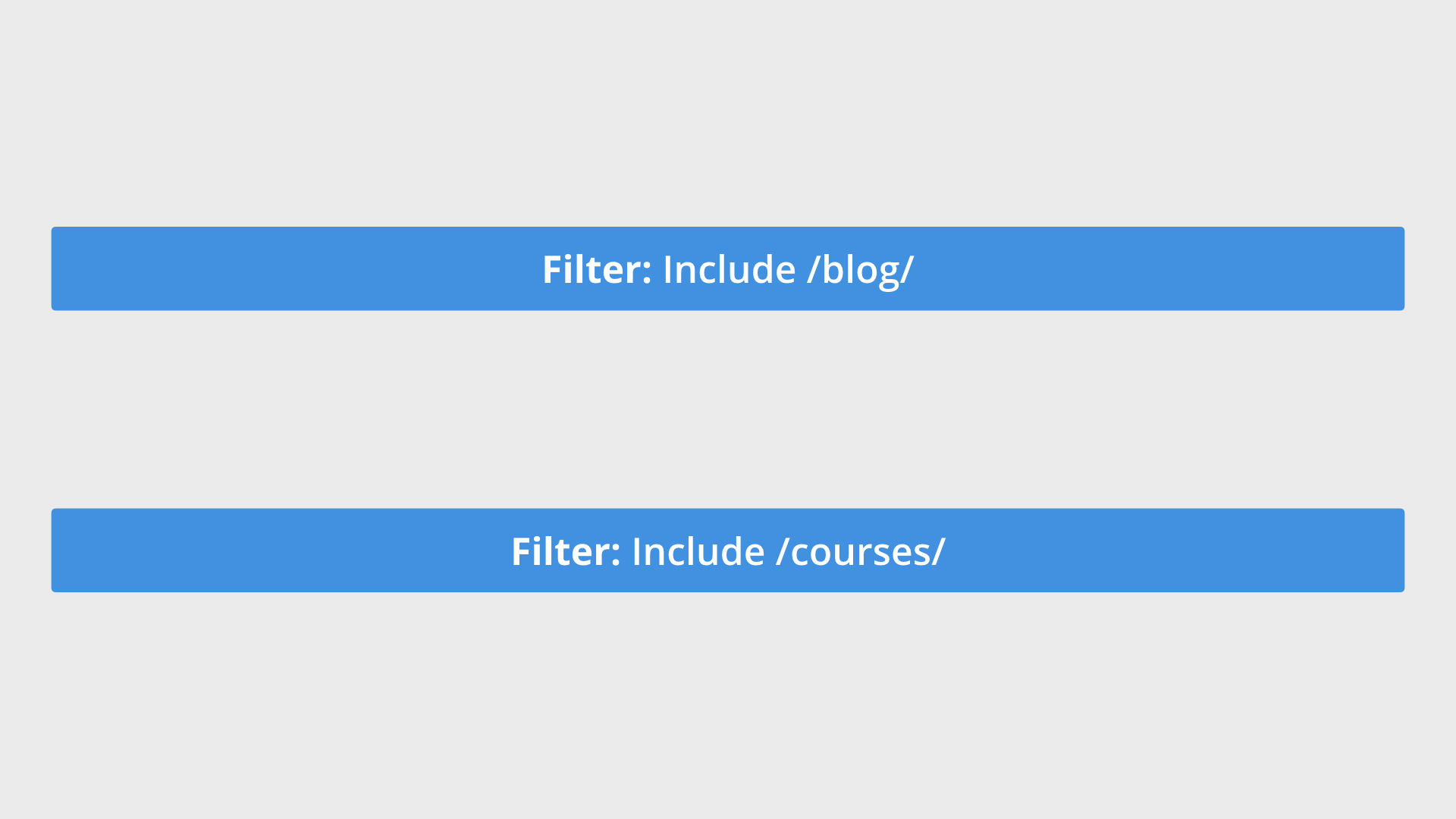
Since filters cascade (with the filter at the top applied first), Google Analytics will compare our data against the filter configuration. In this scenario, simply data for the /blog/ folder will exist allowed through the showtime filter.
The second filter will and then be practical. Since this filter volition only permit information for the /courses/ folder through, it means that no data volition cease up in our reports. Nosotros'll only have zeros.
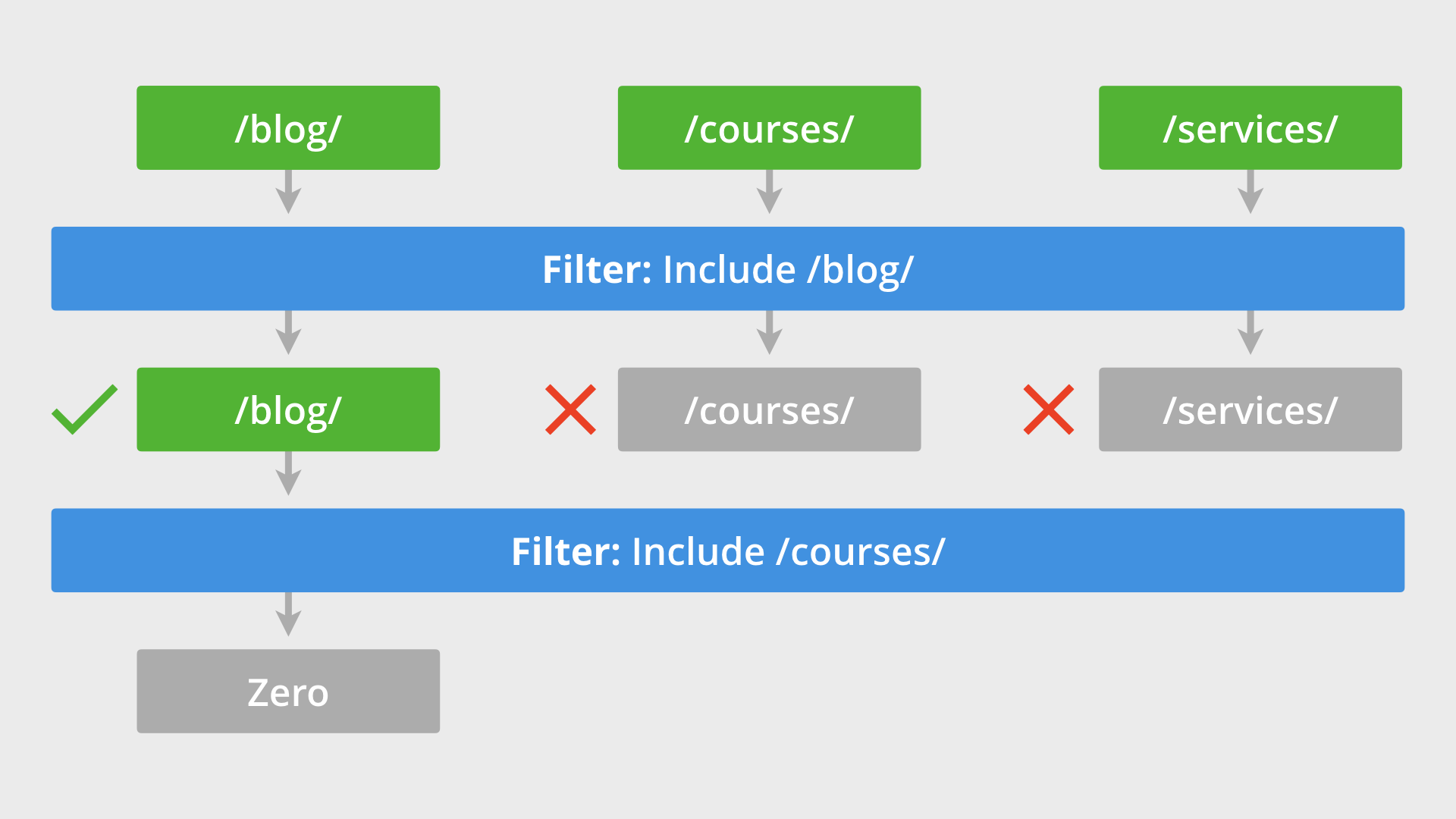
So filters are practical in cascading order. The data we collect passes through each filter (starting at the top). Standing our scenario, this ways that if nosotros practise desire to see data for the two folders in our reports, we'll need to create a unmarried filter that includes all of our criteria.
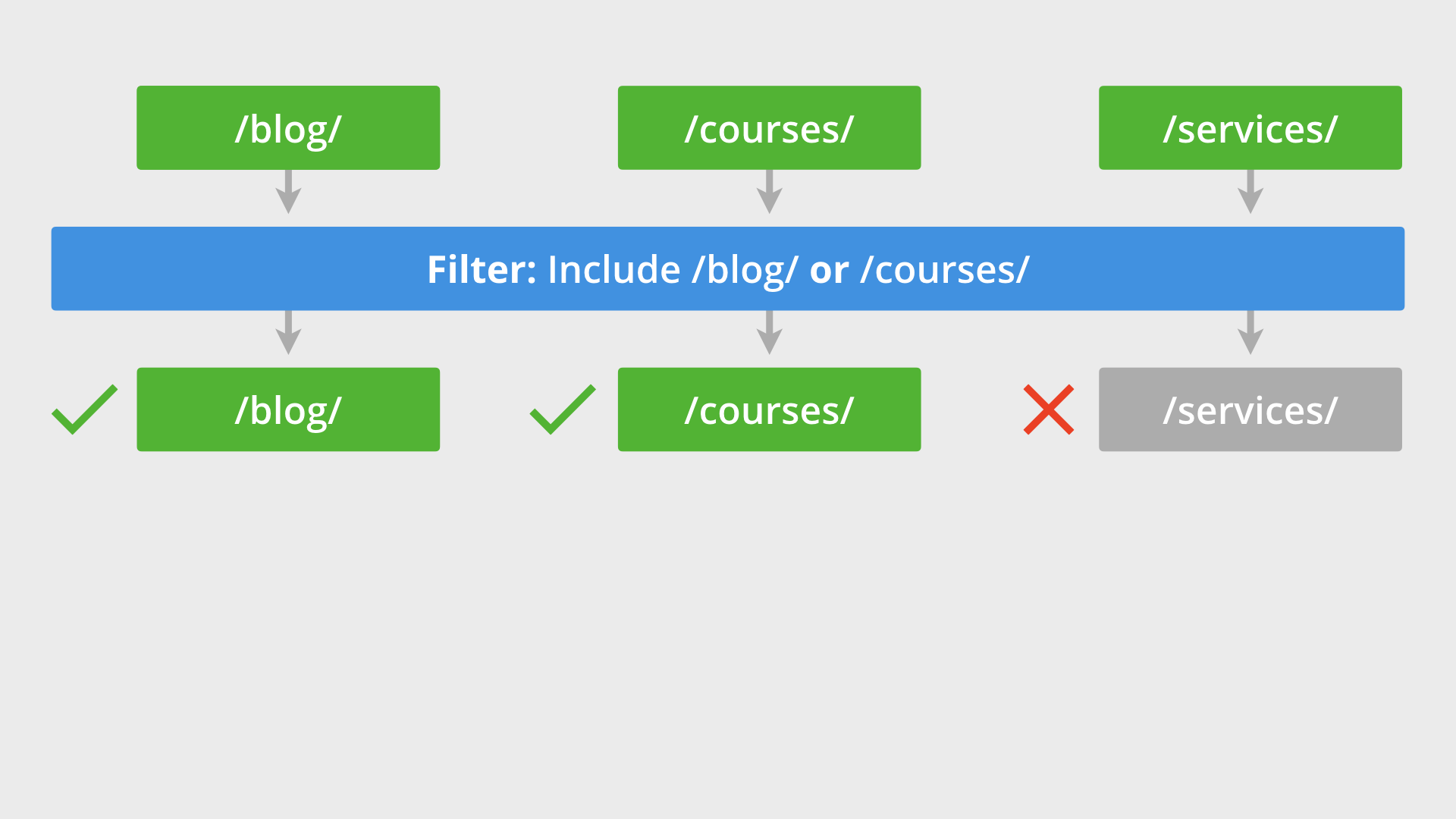
And hither'due south the actual filter we'd utilise:
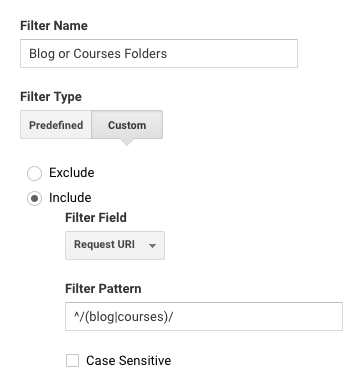
This also emphasizes my recommendation for a testing view if you lot're but getting started with filters. You lot don't want to cease upwards with zeros in your principal set of reports.
What are the critical filters I should create?
Hither are the most important filters you should consider adding to your reporting views inside Google Analytics:
1. Exclude internal traffic
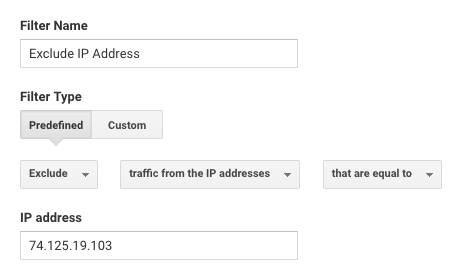
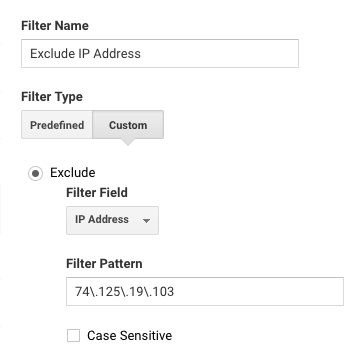
There are different techniques yous can employ to exclude your traffic from your reports. However, the about reliable method I've found is to exclude internal traffic based on a static IP address. (The other methods out there are prone to mistakes and failure.)
To create this filter, you'll need to know the IP address (or addresses) that your organization uses to connect to the internet. Then y'all'll need to create a new filter, like this pre-defined filter:
two. Lowercase campaign tags
If multiple people are creating campaign tags to monitor the performance of your inbound marketing, then you should consider adding filters to force all of your entrada tags to lowercase.
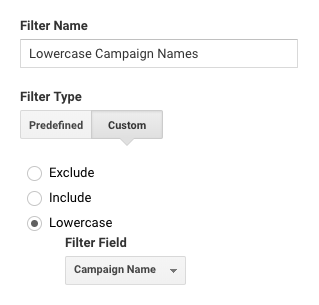
This will clean up the data in your reports then that you don't see split data for Campaign One, Entrada one, and entrada one. Instead, you'll run into combined information for campaign one moving frontward.
You'll need to create boosted lowercase filters for 'Entrada Source', 'Entrada Medium', 'Entrada Term' and 'Entrada Content'.
3. Ensure data accuracy
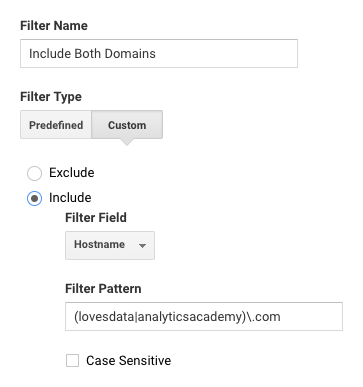
To help ensure you're only collecting data from your websites yous can create an include filter that specifies your domains.
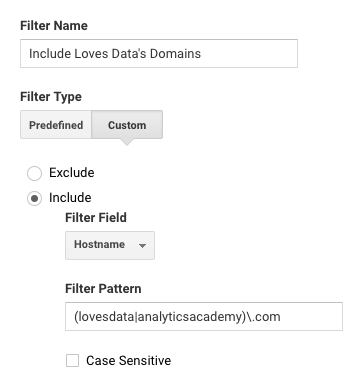
This filter will simply include traffic to lovesdata.com and analyticsacademy.com. If traffic comes from any other websites that accidentally use our tracking code, then that data will exist excluded from our reports.
4. Lowercase page URLs
Sometimes people can view the pages on our website using different capitalization. For case, navigating to the homepage might show the page as /default.aspx or fifty-fifty /Default.aspx. This means that you'll have two separate rows in the 'All Pages' study, fifty-fifty though they're actually the same folio.
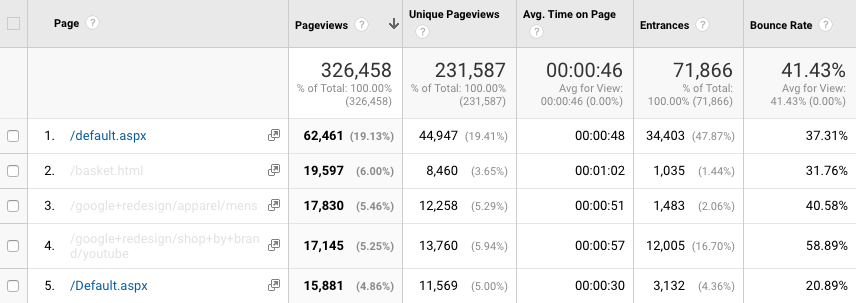
If you notice something like this happening in your reports (navigate to 'Beliefs', then 'Site Content' and select 'All Pages' to check), you should add together a lowercase filter to brand all of your pages lowercase inside your reports.
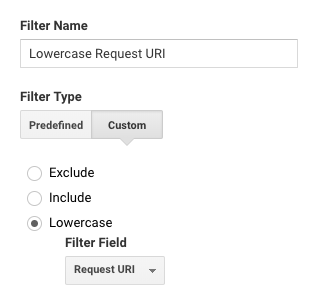
Brand sure you select 'Asking URI' this volition make everything later on your domain name (like /default.aspx) lowercase in your reports.
v. Lowercase site search terms
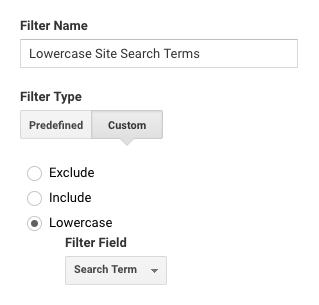
If yous take a search function on your website, and so you lot'll probably detect that people search using unlike capitalization. Someone might search for 'contact us', while someone else searches for 'Contact Us'. You tin can streamline your Site Search reports by adding a lowercase filter to the unlike search terms people are using on your website.
six. Add domain proper name to reports
If you've added your tracking code to multiple websites (for example, if you're using cross-domain tracking) so you'll want to add together this filter to your reporting view:
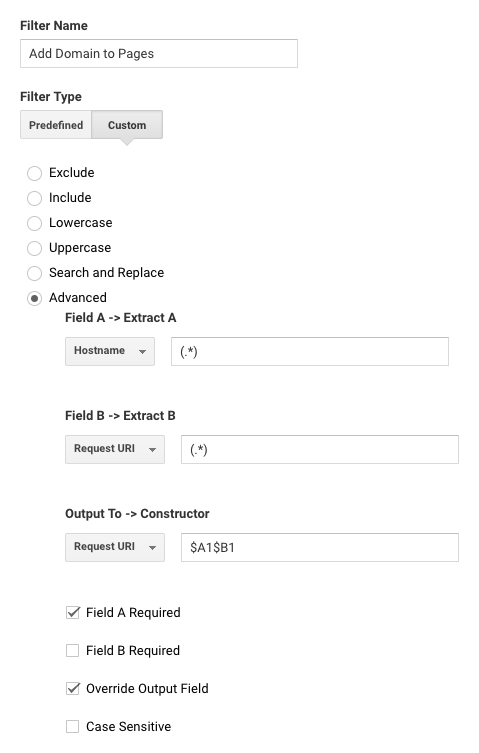
This filter makes information technology easier to encounter how your different websites (and their content) are performing. Applying this filter will mean that you come across www.lovesdata.com/courses/ in the Site Content reports, instead of simply /courses/.
vii. Only include a specific domain (or domains)
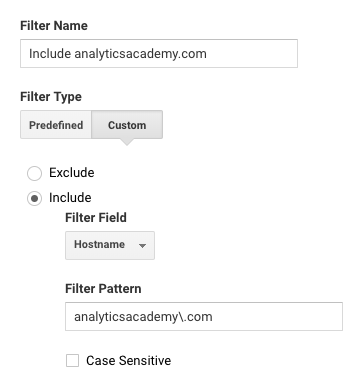
If you take added your tracking code to multiple websites, and then yous can as well use filters to create individual reporting views for each website. For example, let'due south say we've added our tracking code to lovesdata.com and analyticsacademy.com. We can create three reporting views:
- One view that contains data for both websites
- One view that only contains data for lovesdata.com
- One view that merely contains data for analyticsacademy.com
View filter for both websites:
8. Search and supersede
Yous tin use search and replace filters to clean up a range of information in your reports. For case, yous might track form submissions as 'sub_form_01234' using events in Google Analytics. You lot could and then use a search and replace filter to replace this with something more readable like 'Subscribe Course' in your reports.
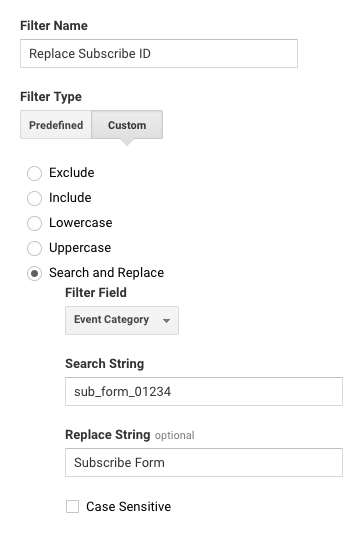
Search and supercede filters are useful if you accept unreadable identifiers or other codes showing up in your reports.
Which filters should I avoid?
Filters have been an of import Google Analytics feature for a long time. They were around before custom segments became available to speed upwards the way we analyze our data. Before segments, we needed to create multiple views for the unlike types of analysis we wanted to perform.
For example, if we only wanted to see the pages that were viewed past people in Canada, then we needed to create a new view, add a filter that merely included our Canadian traffic, and and so wait for enough data to exist available for our analysis. It was painful.
Segments and table filters mean that we don't need to use view filters in some cases. For example, you don't need to create a filtered view that but contains a specific entrada. Y'all can create a segment and apply information technology to your reports instead. Before creating new filters I recommend asking yourself – 'Can I use a segment instead of view filter?'.
Hither are my top recommendations for filters you should Avert using in Google Analytics:
- Include or exclude filters based on campaign tags (including source and medium).
- Include or exclude filters based on geographic locations.
- Include or exclude filters for the different devices people are using to view your website (including mobile, tablet or computer).
- I'd also recommend avoiding filters to exclude query parameters unless you know what you lot're doing. An easy way to remove query parameters is to add together them to your view settings.
Conclusion
Equally we've seen filters are a powerful way to modify the information y'all include (or exclude) in your reports. Remember that unlike segments, filters permanently modify your data, then I recommend applying new filters to your test view before adding them to your primary reporting view

13. What Are The Options For Filtering Data In Google Analytics?,
Source: https://www.lovesdata.com/blog/google-analytics-filters
Posted by: rainescouse1972.blogspot.com
0 Response to "13. What Are The Options For Filtering Data In Google Analytics?"
Post a Comment