

What Happens To Animals When They Undergo Cell Respiration Without Oxygen?
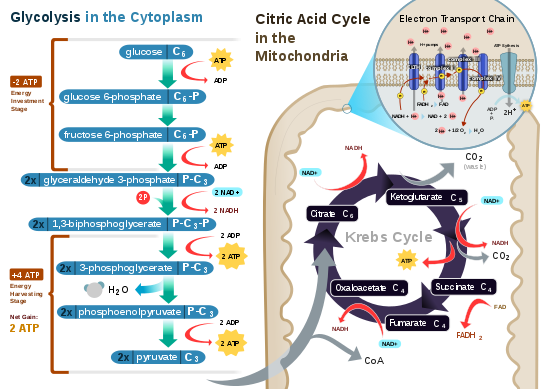
Cellular respiration is a set of metabolic reactions and processes that take place in the cells of organisms to convert chemical energy from nutrients into adenosine triphosphate (ATP), and then release waste products.[ane] The reactions involved in respiration are catabolic reactions, which break large molecules into smaller ones, releasing energy. Respiration is one of the key ways a cell releases chemical energy to fuel cellular activity. The overall reaction occurs in a series of biochemical steps, some of which are redox reactions. Although cellular respiration is technically a combustion reaction, it is an unusual one because of the irksome, controlled release of free energy from the series of reactions.
Nutrients that are normally used past creature and plant cells in respiration include sugar, amino acids and fatty acids, and the most common oxidizing amanuensis is molecular oxygen (O2). The chemical energy stored in ATP (the bond of its third phosphate group to the residual of the molecule can exist broken assuasive more stable products to form, thereby releasing free energy for apply by the cell) can then be used to drive processes requiring energy, including biosynthesis, locomotion or transport of molecules beyond prison cell membranes.
Aerobic respiration
Aerobic respiration requires oxygen (O2) in order to create ATP. Although carbohydrates, fats, and proteins are consumed every bit reactants, aerobic respiration is the preferred method of pyruvate breakup in glycolysis, and requires pyruvate to the mitochondria in lodge to be fully oxidized by the citric acid cycle. The products of this process are carbon dioxide and water, and the energy transferred is used to break bonds in ADP to add a third phosphate group to form ATP (adenosine triphosphate), by substrate-level phosphorylation, NADH and FADH2
| Simplified reaction: | Chalf-dozenH12Osix (s) + 6 Otwo (g) → half-dozen CO2 (g) + half-dozen HtwoO (fifty) + heat |
| ΔG = −2880 kJ per mol of C6H12O6 |
The negative ΔG indicates that the reaction tin can occur spontaneously.
The potential of NADH and FADH2 is converted to more ATP through an electron transport concatenation with oxygen and protons (hydrogen) equally the "terminal electron acceptors". Most of the ATP produced by aerobic cellular respiration is fabricated by oxidative phosphorylation. The energy released is used to create a chemiosmotic potential by pumping protons beyond a membrane. This potential is then used to drive ATP synthase and produce ATP from ADP and a phosphate group. Biological science textbooks oft state that 38 ATP molecules can exist made per oxidized glucose molecule during cellular respiration (2 from glycolysis, 2 from the Krebs cycle, and virtually 34 from the electron transport system).[2] However, this maximum yield is never quite reached because of losses due to leaky membranes besides as the cost of moving pyruvate and ADP into the mitochondrial matrix, and electric current estimates range around 29 to 30 ATP per glucose.[two]
Aerobic metabolism is up to 15 times more efficient than anaerobic metabolism (which yields 2 molecules ATP per one molecule glucose). Even so, some anaerobic organisms, such equally methanogens are able to continue with anaerobic respiration, yielding more ATP by using inorganic molecules other than oxygen as final electron acceptors in the electron send chain. They share the initial pathway of glycolysis but aerobic metabolism continues with the Krebs cycle and oxidative phosphorylation. The postal service-glycolytic reactions take identify in the mitochondria in eukaryotic cells, and in the cytoplasm in prokaryotic cells.
Although plants are cyberspace consumers of carbon dioxide and producers of oxygen via photosynthesis, plant respiration accounts for near half of the COtwo generated annually by terrestrial ecosystems.[iii] [iv] : 87
Glycolysis
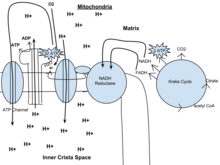
Out of the cytoplasm it goes into the Krebs cycle with the acetyl CoA. It and so mixes with CO2 and makes ii ATP, NADH, and FADH. From there the NADH and FADH become into the NADH reductase, which produces the enzyme. The NADH pulls the enzyme's electrons to send through the electron send concatenation. The electron transport chain pulls H+ ions through the concatenation. From the electron ship chain, the released hydrogen ions make ADP for an result of 32 ATP. Lastly, ATP leaves through the ATP channel and out of the mitochondria.
Glycolysis is a metabolic pathway that takes place in the cytosol of cells in all living organisms. Glycolysis can be literally translated every bit "sugar splitting",[5] and occurs with or without the presence of oxygen. In aerobic conditions, the process converts one molecule of glucose into two molecules of pyruvate (pyruvic acid), generating energy in the form of two net molecules of ATP. Four molecules of ATP per glucose are actually produced, but two are consumed as part of the preparatory phase. The initial phosphorylation of glucose is required to increment the reactivity (decrease its stability) in lodge for the molecule to be broken into two pyruvate molecules by the enzyme aldolase. During the pay-off phase of glycolysis, four phosphate groups are transferred to ADP by substrate-level phosphorylation to make 4 ATP, and two NADH are produced when the pyruvate is oxidized. The overall reaction can be expressed this way:
- Glucose + ii NAD+ + 2 Pi + 2 ADP → 2 pyruvate + two H+ + ii NADH + 2 ATP + 2 H+ + ii HiiO + energy
Starting with glucose, 1 ATP is used to donate a phosphate to glucose to produce glucose 6-phosphate. Glycogen tin can be converted into glucose six-phosphate likewise with the help of glycogen phosphorylase. During energy metabolism, glucose 6-phosphate becomes fructose 6-phosphate. An additional ATP is used to phosphorylate fructose 6-phosphate into fructose one,6-bisphosphate by the help of phosphofructokinase. Fructose 1,6-biphosphate then splits into two phosphorylated molecules with three carbon chains which later degrades into pyruvate.[4] : 88–90
Oxidative decarboxylation of pyruvate
Pyruvate is oxidized to acetyl-CoA and COtwo past the pyruvate dehydrogenase complex (PDC). The PDC contains multiple copies of iii enzymes and is located in the mitochondria of eukaryotic cells and in the cytosol of prokaryotes. In the conversion of pyruvate to acetyl-CoA, one molecule of NADH and one molecule of CO2 is formed.
Citric acid wheel
This is also chosen the Krebs cycle or the tricarboxylic acid cycle. When oxygen is nowadays, acetyl-CoA is produced from the pyruvate molecules created from glycolysis. Once acetyl-CoA is formed, aerobic or anaerobic respiration tin can occur. When oxygen is nowadays, the mitochondria will undergo aerobic respiration which leads to the Krebs cycle. However, if oxygen is not nowadays, fermentation of the pyruvate molecule volition occur. In the presence of oxygen, when acetyl-CoA is produced, the molecule then enters the citric acid cycle (Krebs cycle) inside the mitochondrial matrix, and is oxidized to COtwo while at the same time reducing NAD to NADH. NADH can be used past the electron send concatenation to create further ATP equally part of oxidative phosphorylation. To fully oxidize the equivalent of ane glucose molecule, 2 acetyl-CoA must be metabolized by the Krebs cycle. Two low-free energy waste products, H2O and CO2, are created during this bicycle.[6] [seven]
The citric acid cycle is an 8-footstep process involving 18 dissimilar enzymes and co-enzymes. During the bike, acetyl-CoA (2 carbons) + oxaloacetate (4 carbons) yields citrate (6 carbons), which is rearranged to a more reactive form called isocitrate (half-dozen carbons). Isocitrate is modified to become α-ketoglutarate (5 carbons), succinyl-CoA, succinate, fumarate, malate, and, finally, oxaloacetate.
The net gain from i cycle is 3 NADH and i FADH2 every bit hydrogen- (proton plus electron)-carrying compounds and one high-free energy GTP, which may afterwards be used to produce ATP. Thus, the total yield from 1 glucose molecule (2 pyruvate molecules) is 6 NADH, ii FADHtwo, and ii ATP.[6] [seven] [iv] : xc–91
Oxidative phosphorylation
In eukaryotes, oxidative phosphorylation occurs in the mitochondrial cristae. It comprises the electron transport chain that establishes a proton gradient (chemiosmotic potential) across the boundary of the inner membrane by oxidizing the NADH produced from the Krebs cycle. ATP is synthesized by the ATP synthase enzyme when the chemiosmotic gradient is used to bulldoze the phosphorylation of ADP. The electrons are finally transferred to exogenous oxygen and, with the add-on of two protons, water is formed.
Efficiency of ATP production
The table below describes the reactions involved when one glucose molecule is fully oxidized into carbon dioxide. It is assumed that all the reduced coenzymes are oxidized past the electron send chain and used for oxidative phosphorylation.
| Step | coenzyme yield | ATP yield | Source of ATP |
|---|---|---|---|
| Glycolysis preparatory stage | −two | Phosphorylation of glucose and fructose 6-phosphate uses two ATP from the cytoplasm. | |
| Glycolysis pay-off phase | iv | Substrate-level phosphorylation | |
| 2 NADH | 3 or 5 | Oxidative phosphorylation : Each NADH produces cyberspace one.5 ATP (instead of usual 2.5) due to NADH transport over the mitochondrial membrane | |
| Oxidative decarboxylation of pyruvate | ii NADH | 5 | Oxidative phosphorylation |
| Krebs cycle | 2 | Substrate-level phosphorylation | |
| 6 NADH | 15 | Oxidative phosphorylation | |
| 2 FADH2 | 3 | Oxidative phosphorylation | |
| Total yield | thirty or 32 ATP | From the complete oxidation of one glucose molecule to carbon dioxide and oxidation of all the reduced coenzymes. | |
Although in that location is a theoretical yield of 38 ATP molecules per glucose during cellular respiration, such atmospheric condition are by and large not realized because of losses such as the cost of moving pyruvate (from glycolysis), phosphate, and ADP (substrates for ATP synthesis) into the mitochondria. All are actively transported using carriers that utilize the stored energy in the proton electrochemical gradient.
- Pyruvate is taken up by a specific, depression Chiliad yard transporter to bring it into the mitochondrial matrix for oxidation by the pyruvate dehydrogenase circuitous.
- The phosphate carrier (PiC) mediates the electroneutral exchange (antiport) of phosphate (HiiPO4 −; Pi) for OH− or symport of phosphate and protons (H+) across the inner membrane, and the driving force for moving phosphate ions into the mitochondria is the proton motive forcefulness.
- The ATP-ADP translocase (also chosen adenine nucleotide translocase, Pismire) is an antiporter and exchanges ADP and ATP beyond the inner membrane. The driving force is due to the ATP (−4) having a more negative charge than the ADP (−3), and thus it dissipates some of the electrical component of the proton electrochemical gradient.
The outcome of these send processes using the proton electrochemical slope is that more than 3 H+ are needed to make 1 ATP. Evidently, this reduces the theoretical efficiency of the whole process and the probable maximum is closer to 28–thirty ATP molecules.[2] In practice the efficiency may be even lower considering the inner membrane of the mitochondria is slightly leaky to protons.[eight] Other factors may also misemploy the proton slope creating an patently leaky mitochondria. An uncoupling protein known as thermogenin is expressed in some jail cell types and is a channel that can ship protons. When this protein is active in the inner membrane it short circuits the coupling between the electron send chain and ATP synthesis. The potential energy from the proton gradient is not used to make ATP but generates rut. This is particularly important in dark-brown fatty thermogenesis of newborn and hibernating mammals.
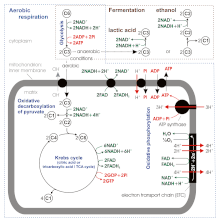
According to some newer sources, the ATP yield during aerobic respiration is not 36–38, only only about 30–32 ATP molecules / 1 molecule of glucose [9], considering:
- ATP : NADH+H+ and ATP : FADH2 ratios during the oxidative phosphorylation announced to be not 3 and 2, but 2.five and 1.v respectively. Unlike in the substrate-level phosphorylation, the stoichiometry here is difficult to constitute.
- ATP synthase produces 1 ATP / three H+. However the exchange of matrix ATP for cytosolic ADP and Pi (antiport with OH− or symport with H+) mediated past ATP–ADP translocase and phosphate carrier consumes i H+ / 1 ATP as a result of regeneration of the transmembrane potential inverse during this transfer, so the net ratio is 1 ATP : 4 H+.
- The mitochondrial electron ship chain proton pump transfers across the inner membrane 10 H+ / 1 NADH+H+ (4 + 2 + 4) or vi H+ / 1 FADH2 (ii + iv).
- So the final stoichiometry is
- 1 NADH+H+ : 10 H+ : 10/four ATP = i NADH+H+ : ii.5 ATP
- i FADH2 : six H+ : 6/four ATP = 1 FADH2 : 1.v ATP
- ATP : NADH+H+ coming from glycolysis ratio during the oxidative phosphorylation is
- i.5, every bit for FADHtwo, if hydrogen atoms (2H++2e−) are transferred from cytosolic NADH+H+ to mitochondrial FAD by the glycerol phosphate shuttle located in the inner mitochondrial membrane.
- 2.v in instance of malate-aspartate shuttle transferring hydrogen atoms from cytosolic NADH+H+ to mitochondrial NAD+
So finally nosotros take, per molecule of glucose
- Substrate-level phosphorylation: 2 ATP from glycolysis + 2 ATP (directly GTP) from Krebs cycle
- Oxidative phosphorylation
- 2 NADH+H+ from glycolysis: ii × 1.5 ATP (if glycerol phosphate shuttle transfers hydrogen atoms) or ii × ii.five ATP (malate-aspartate shuttle)
- 2 NADH+H+ from the oxidative decarboxylation of pyruvate and 6 from Krebs cycle: viii × ii.5 ATP
- 2 FADHtwo from the Krebs bicycle: two × 1.5 ATP
Altogether this gives 4 + 3 (or 5) + 20 + 3 = 30 (or 32) ATP per molecule of glucose
These figures may still require farther tweaking as new structural details go available. The above value of 3 H+/ATP for the synthase assumes that the synthase translocates 9 protons, and produces 3 ATP, per rotation. The number of protons depends on the number of c subunits in the Fo c-ring, and it is now known that this is 10 in yeast Fo[x] and 8 for vertebrates.[11] Including 1 H+ for the send reactions, this means that synthesis of one ATP requires 1+10/iii=4.33 protons in yeast and i+8/three = 3.67 in vertebrates. This would imply that in homo mitochondria the 10 protons from oxidizing NADH would produce two.72 ATP (instead of 2.5) and the 6 protons from oxidizing succinate or ubiquinol would produce 1.64 ATP (instead of 1.5). This is consistent with experimental results within the margin of error described in a contempo review.[12]
The total ATP yield in ethanol or lactic acid fermentation is only 2 molecules coming from glycolysis, because pyruvate is not transferred to the mitochondrion and finally oxidized to the carbon dioxide (CO2), but reduced to ethanol or lactic acrid in the cytoplasm.[ix]
Fermentation
Without oxygen, pyruvate (pyruvic acid) is not metabolized by cellular respiration but undergoes a procedure of fermentation. The pyruvate is not transported into the mitochondrion but remains in the cytoplasm, where it is converted to waste products that may be removed from the prison cell. This serves the purpose of oxidizing the electron carriers so that they can perform glycolysis again and removing the excess pyruvate. Fermentation oxidizes NADH to NAD+ and so it can be re-used in glycolysis. In the absence of oxygen, fermentation prevents the buildup of NADH in the cytoplasm and provides NAD+ for glycolysis. This waste product varies depending on the organism. In skeletal muscles, the waste material product is lactic acid. This type of fermentation is chosen lactic acid fermentation. In strenuous practice, when free energy demands exceed energy supply, the respiratory chain cannot procedure all of the hydrogen atoms joined past NADH. During anaerobic glycolysis, NAD+ regenerates when pairs of hydrogen combine with pyruvate to form lactate. Lactate formation is catalyzed by lactate dehydrogenase in a reversible reaction. Lactate tin can also exist used as an indirect precursor for liver glycogen. During recovery, when oxygen becomes available, NAD+ attaches to hydrogen from lactate to class ATP. In yeast, the waste product products are ethanol and carbon dioxide. This type of fermentation is known equally alcoholic or ethanol fermentation. The ATP generated in this process is fabricated by substrate-level phosphorylation, which does non require oxygen.
Fermentation is less efficient at using the free energy from glucose: only 2 ATP are produced per glucose, compared to the 38 ATP per glucose nominally produced past aerobic respiration. Glycolytic ATP, however, is created more quickly. For prokaryotes to continue a rapid growth rate when they are shifted from an aerobic environment to an anaerobic environment, they must increase the rate of the glycolytic reactions. For multicellular organisms, during short bursts of strenuous activity, muscle cells utilise fermentation to supplement the ATP production from the slower aerobic respiration, so fermentation may be used by a cell even before the oxygen levels are depleted, as is the example in sports that do not crave athletes to pace themselves, such as sprinting.
Anaerobic respiration
Cellular respiration is the process by which biological fuels are oxidised in the presence of an inorganic electron acceptor such equally oxygen to produce large amounts of energy, to bulldoze the majority production of ATP.
Anaerobic respiration is used by microorganisms chosen archaea in which neither oxygen (aerobic respiration) nor pyruvate derivatives (fermentation) is the concluding electron acceptor. Rather, an inorganic acceptor such as sulfate (SO4 2-), nitrate (NO3 –), or sulfur (Southward) is used.[13] Such organisms are typically establish in unusual places such as underwater caves or near hydrothermal vents at the bottom of the ocean.[iv] : 66–68
In July 2019, a scientific study of Kidd Mine in Canada discovered sulfur-breathing organisms which alive 7900 feet below the surface, and which exhale sulfur in order to survive. These organisms are also remarkable due to consuming minerals such as pyrite as their food source.[14] [xv] [16]
Meet also
- Maintenance respiration: maintenance equally a functional component of cellular respiration
- Microphysiometry
- Pasteur point
- Respirometry: enquiry tool to explore cellular respiration
- Tetrazolium chloride: cellular respiration indicator
- Complex 1: NADH:ubiquinone oxidoreductes
References
- ^ Bailey, Regina. "Cellular Respiration". Archived from the original on 2012-05-05.
- ^ a b c Rich, P. R. (2003). "The molecular machinery of Keilin'south respiratory concatenation". Biochemical Society Transactions. 31 (Pt 6): 1095–1105. doi:x.1042/BST0311095. PMID 14641005.
- ^ O'Leary, Brendan Chiliad.; Plaxton, William C. (2016). "Plant Respiration". eLS. pp. 1–11. doi:x.1002/9780470015902.a0001301.pub3. ISBN9780470016176.
- ^ a b c d Mannion, A. M. (12 January 2006). Carbon and Its Domestication. Springer. ISBN978-1-4020-3956-0.
- ^ Reece, Jane; Urry, Lisa; Cain, Michael; Wasserman, Steven; Minorsky, Peter; Jackson, Robert (2010). Campbell Biology Ninth Edition. Pearson Education, Inc. p. 168.
- ^ a b R. Caspi (2012-11-14). "Pathway: TCA bicycle III (animals)". MetaCyc Metabolic Pathway Database. Retrieved 2022-06-twenty .
- ^ a b R. Caspi (2011-12-19). "Pathway: TCA cycle I (prokaryotic)". MetaCyc Metabolic Pathway Database. Retrieved 2022-06-twenty .
- ^ Porter, R.; Make, Thousand. (1 September 1995). "Mitochondrial proton conductance and H+/O ratio are independent of electron transport rate in isolated hepatocytes". The Biochemical Journal (Free full text). 310 (Pt ii): 379–382. doi:ten.1042/bj3100379. ISSN 0264-6021. PMC1135905. PMID 7654171.
- ^ a b c Stryer, Lubert (1995). Biochemistry (fourth ed.). New York – Basingstoke: W. H. Freeman and Visitor. ISBN978-0716720096.
- ^ Stock D, Leslie AG, Walker JE (1999). "Molecular architecture of the rotary motor in ATP synthase". Scientific discipline. 286 (5445): 1700–five. doi:10.1126/science.286.5445.1700. PMID 10576729.
{{cite journal}}: CS1 maint: uses authors parameter (link) - ^ Watt, I.N., Montgomery, Thousand.One thousand., Runswick, M.J., Leslie, A.G.W., Walker, J.E. (2010). "Bioenergetic Cost of Making an Adenosine Triphosphate Molecule in Animal Mitochondria". Proc. Natl. Acad. Sci. USA. 107 (39): 16823–16827. doi:10.1073/pnas.1011099107. PMC2947889. PMID 20847295.
{{cite journal}}: CS1 maint: uses authors parameter (link) - ^ P.Hinkle (2005). "P/O ratios of mitochondrial oxidative phosphorylation". Biochimica et Biophysica Acta (BBA) - Bioenergetics. 1706 (1–2): 1–11. doi:10.1016/j.bbabio.2004.09.004. PMID 15620362.
- ^ Lumen Boundless Microbiology. "Anaerobic Respiration-Electron Donors and Acceptors in Anaerobic Respiration". courses.lumenlearning.org. Boundless.com. Retrieved November 19, 2020.
Anaerobic respiration is the formation of ATP without oxygen. This method nonetheless incorporates the respiratory electron send concatenation, merely without using oxygen as the terminal electron acceptor. Instead, molecules such as sulfate (SO42-), nitrate (NO3–), or sulfur (S) are used as electron acceptors
- ^ Lollar, Garnet S.; Warr, Oliver; Telling, Jon; Osburn, Magdalena R.; Sherwood Lollar, Barbara (2019). "'Follow the H2o': Hydrogeochemical Constraints on Microbial Investigations 2.four km Below Surface at the Kidd Creek Deep Fluid and Deep Life Observatory". Geomicrobiology Periodical. 36: 859–872. doi:10.1080/01490451.2019.1641770. S2CID 199636268.
- ^ World'southward Oldest Groundwater Supports Life Through H2o-Rock Chemistry Archived 2019-09-10 at the Wayback Machine, July 29, 2019, deepcarbon.net.
- ^ Strange life-forms found deep in a mine signal to vast 'underground Galapagos' Archived 2019-09-09 at the Wayback Machine, By Corey Southward. Powell, Sept. 7, 2019, nbcnews.com.
External links
- A detailed description of respiration vs. fermentation
- Kimball'south online resource for cellular respiration
- Cellular Respiration and Fermentation at Clermont College
Source: https://en.wikipedia.org/wiki/Cellular_respiration
Posted by: rainescouse1972.blogspot.com
0 Response to "What Happens To Animals When They Undergo Cell Respiration Without Oxygen?"
Post a Comment